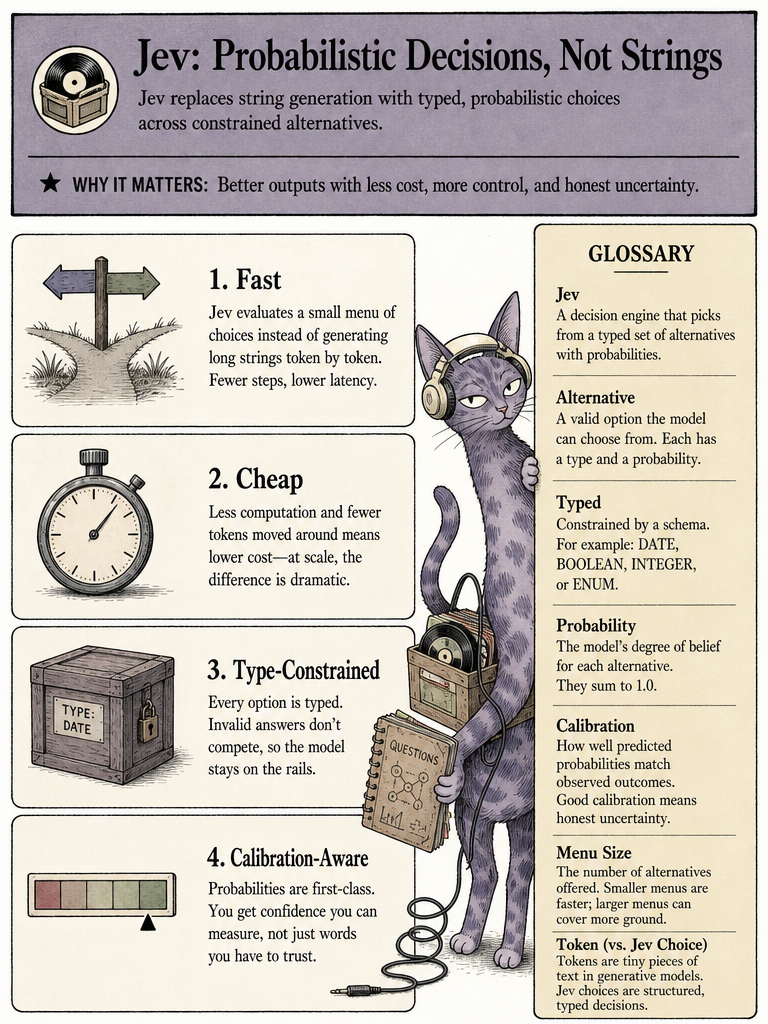
Jev outputs decisions, not strings.
Key idea & notes ▾
WHY THIS MATTERSIt could make embedding intelligence into software vastly cheaper and faster.

The universal-LLM pattern wastes generation on tiny bounded choices.
Key idea & notes ▾
WHY THIS MATTERSRecognizing this waste is the first step to cheaper agent design.

Jev removes the generate-then-parse detour to a decision.
Key idea & notes ▾
WHY THIS MATTERSA shorter path means less latency, cost, and failure surface.

Jev is the fast System One layer whose cheapness invites ubiquity.
Key idea & notes ▾
WHY THIS MATTERSThe naming captures a real economic incentive to embed judgment everywhere.

Three primitives cover most bounded decisions.
Key idea & notes ▾
WHY THIS MATTERSA small, learnable interface makes decision modeling practical.
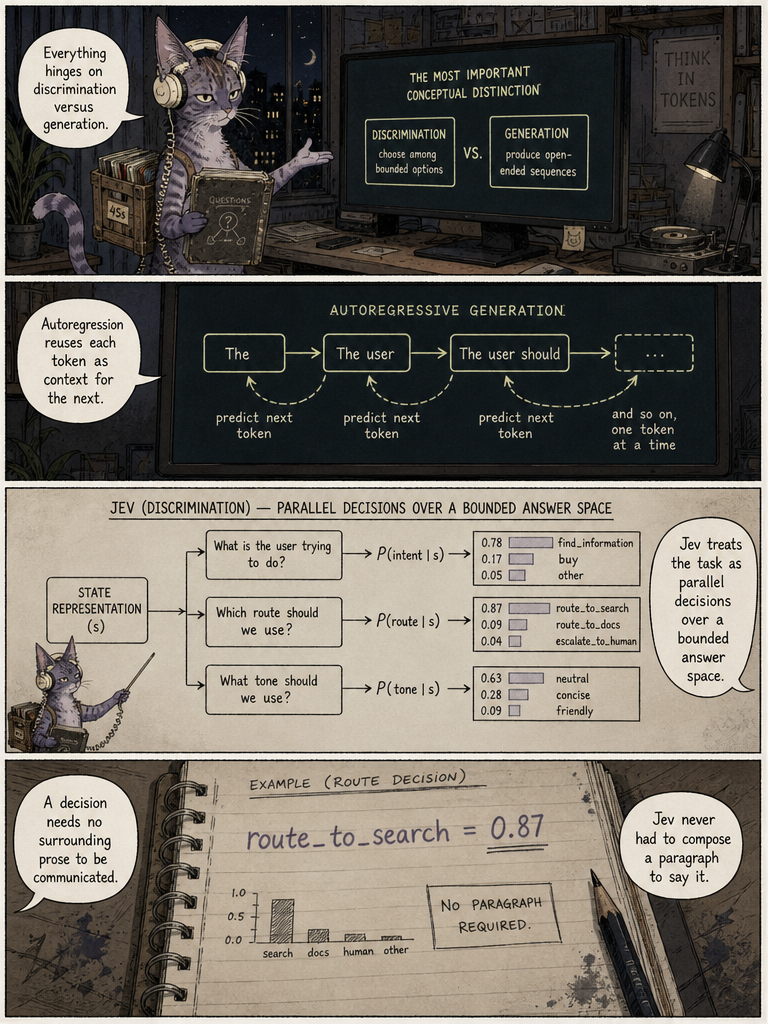
Discrimination over a fixed space differs fundamentally from token generation.
Key idea & notes ▾
WHY THIS MATTERSThis framing explains Jev's speed, cost, and safety advantages at once.

Parallel decision evaluation avoids slow sequential decoding.
Key idea & notes ▾
WHY THIS MATTERSFaster control loops make richer agent workflows feasible.
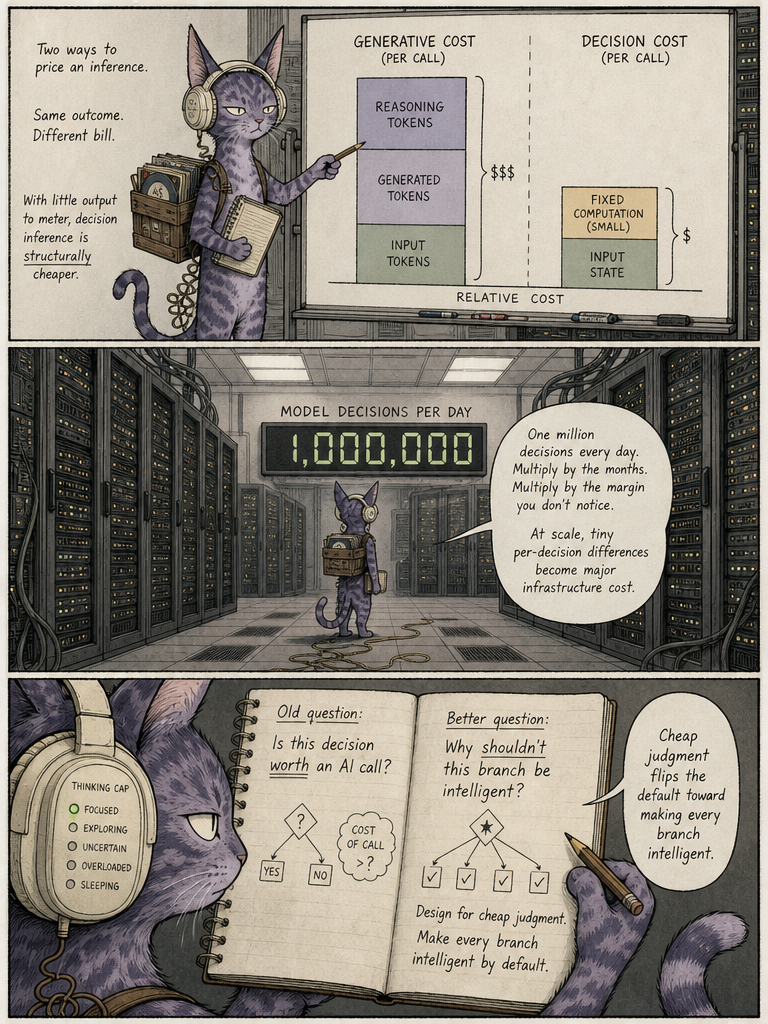
Little output to meter makes decision inference structurally cheap.
Key idea & notes ▾
WHY THIS MATTERSCheap judgment changes product design, not just budgets.

Typed output prevents out-of-schema errors but not all errors.
Key idea & notes ▾
WHY THIS MATTERSConstraining the failure surface is valuable for autonomous systems.

Calibrated confidence becomes a first-class model contract.
Key idea & notes ▾
WHY THIS MATTERSTrustworthy probabilities let systems automate safely and escalate wisely.
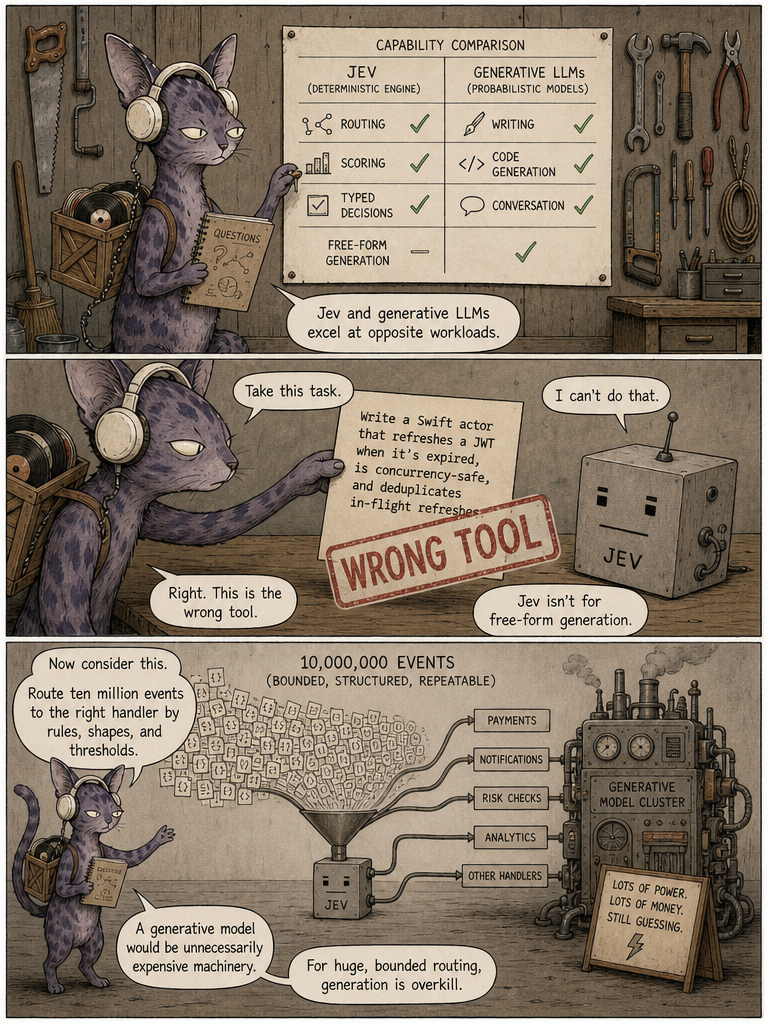
Pick the right model for the right computational job.
Key idea & notes ▾
WHY THIS MATTERSTool-fit thinking prevents both overspending and capability gaps.

Splitting roles keeps expensive generation to where it helps.
Key idea & notes ▾
WHY THIS MATTERSDifferentiated architectures cut agent cost and latency dramatically.
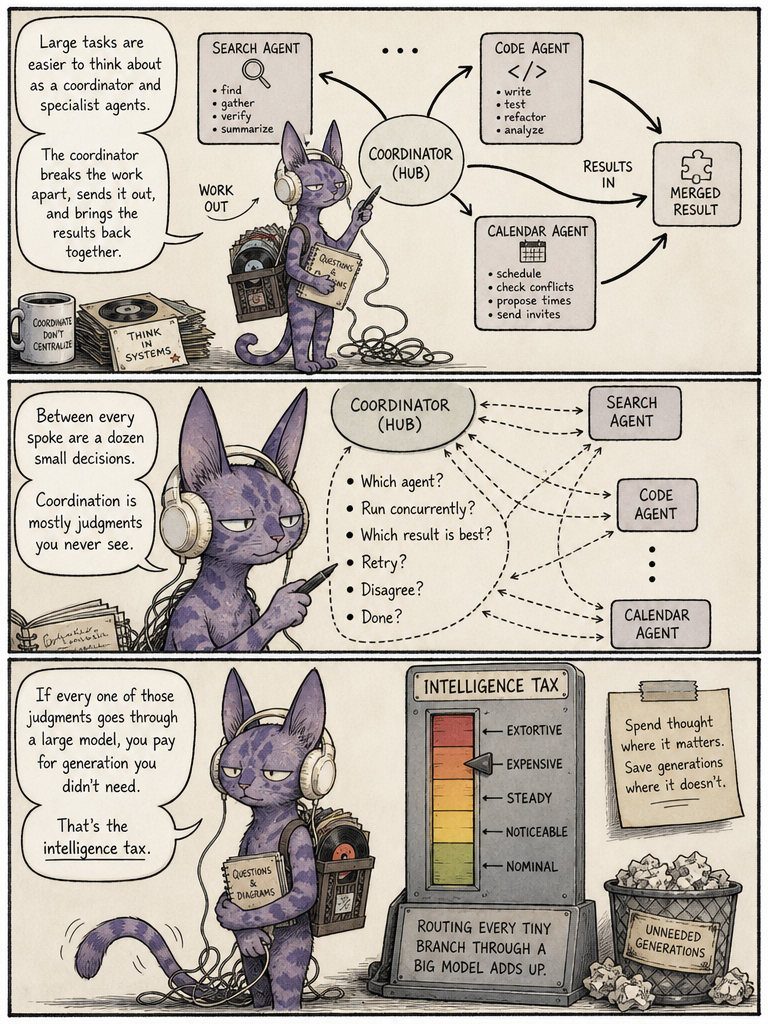
Coordination decisions dominate cost in multi-agent systems.
Key idea & notes ▾
WHY THIS MATTERSCheap control decisions make agent swarms economically viable.

Layered Jev-plus-LLM design mirrors a cognitive architecture.
Key idea & notes ▾
WHY THIS MATTERSIt shows engineers a concrete, buildable pattern today.

Jev fits everywhere a system needs bounded judgment.
Key idea & notes ▾
WHY THIS MATTERSThese are the exact spots where LLM calls quietly drain budgets.

Jev narrows the failure surface but doesn't eliminate errors.
Key idea & notes ▾
WHY THIS MATTERSHonest limits prevent dangerous overtrust in autonomous systems.
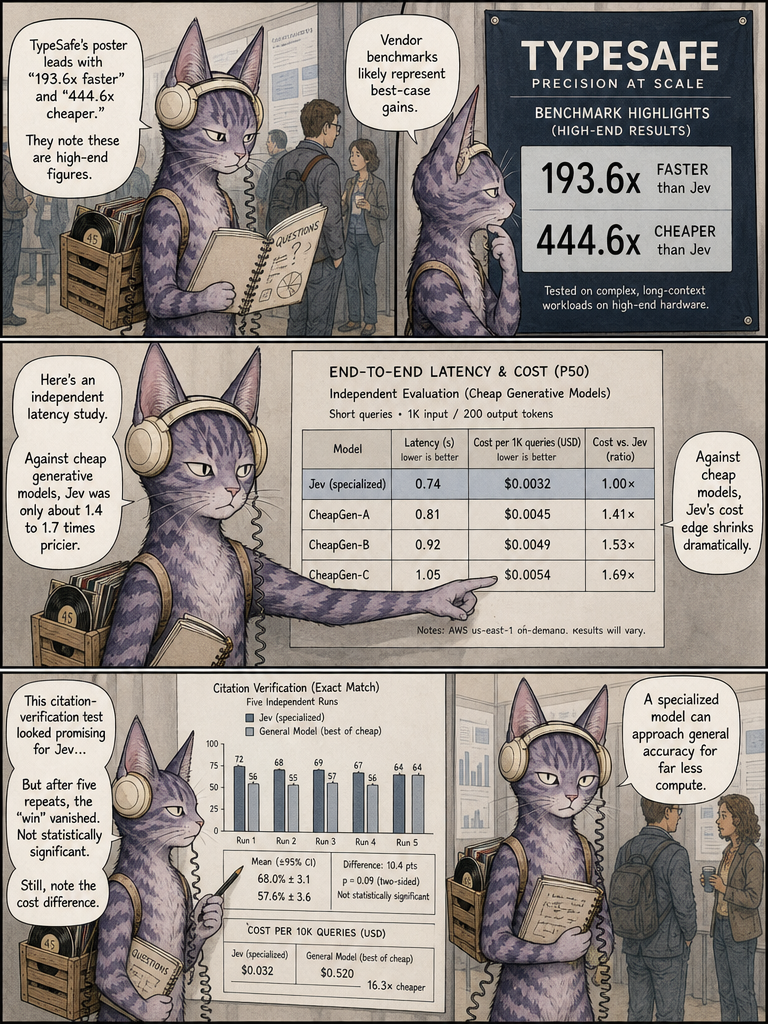
Jev's advantage depends strongly on which model it replaces.
Key idea & notes ▾
WHY THIS MATTERSEngineers should benchmark against their actual baseline, not headlines.

Jev requires a definable, bounded answer space.
Key idea & notes ▾
WHY THIS MATTERSKnowing where Jev fails saves teams from misapplying it.
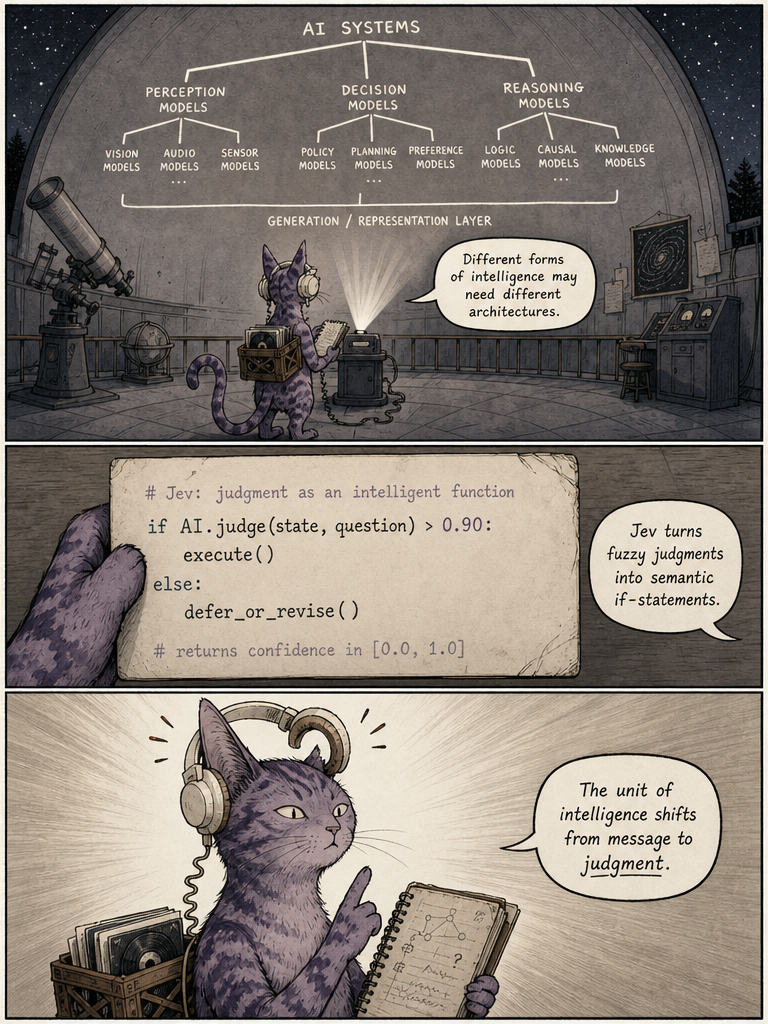
Judgment can be a first-class intelligence primitive.
Key idea & notes ▾
WHY THIS MATTERSTreating judgment as a function reshapes how software embeds intelligence.

Ask which parts of a system actually need an LLM.
Key idea & notes ▾
WHY THIS MATTERSThis reframing can make agents cheaper, faster, and easier to inspect.
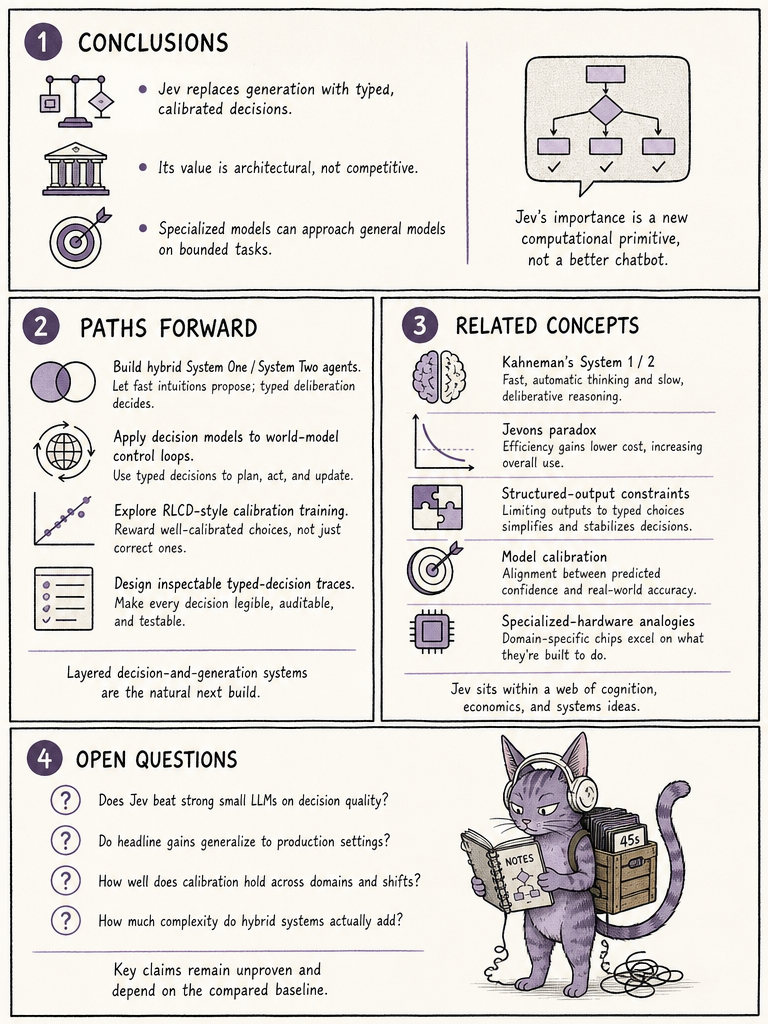
Jev's promise is real but its generalization remains an open empirical question.
Key idea & notes ▾
WHY THIS MATTERSKnowing what's proven versus unproven guides responsible adoption.